I once watched my sister Anju type the same price into WhatsApp forty times in one evening. Same soap, same ₹120, same "plus ₹60 delivery". That evening is the reason her catalogue exists, and the reason this article does. If you want to sell handmade products on WhatsApp, the app already has the tools; most people never open them.
The short version
- Instagram is where strangers find you. WhatsApp is where the sale closes. Use them in that order, and expect WhatsApp to do all the work for the first three months.
- Set up WhatsApp Business properly: profile, catalogue, quick replies, labels. It takes one evening and saves you an hour a day.
- Status is free reach to people who already trust you. Broadcast lists reach the ones who have bought. Groups annoy everyone.
- The message that gets replies is short, has one photo, one price, one delivery line and ends with a question.
- Your first ten customers are already in your contact list. Ask them directly, one at a time.
You do not need a website. You do not need to run ads. I have built the website and I have run the ads, and the honest position in 2026 is that a home maker with a phone, a good product and a contact list of 300 people will outsell a badly run online store every month of the year.
What you need is a system: a way to show the product, a way to answer the price question once instead of forty times, and a way to ask for the order without feeling like a salesman. That is what the next eight sections build.
The order of thingsWhy you sell handmade products on WhatsApp and only find them on Instagram
People buy from people they trust, and in India trust lives on WhatsApp. Your cousin, your neighbour, your children's teacher and the woman from the society committee are all there, and all of them have your number saved. A photo on your status reaches them without asking permission.
Instagram is the opposite. Nobody there knows you. What it does is let a stranger in another city stumble on a fifteen-second reel of you pouring soap, watch it twice, and tap the WhatsApp button in your bio. Then she is on WhatsApp, where the trust is built and the sale is closed.
So the shape is: WhatsApp first, Instagram second, and the Instagram bio pointing straight back to WhatsApp. Anyone who tells you to start with a website or a marketplace has not sold a bar of soap. I wrote separately about whether Amazon and Meesho are worth it; the short answer is not yet.
The setupHow to sell handmade products on WhatsApp: one evening of setup
Install WhatsApp Business, ideally on a second number
It is a separate app, free, and it looks like the one you already use. A second SIM for the business keeps your personal chats out of it and lets you switch the phone to silent at night without missing a family call. Fill the profile completely: business name, what you make, your city, hours, and a profile photo of the product, not a logo.
Build the catalogue before you post anything
Settings, Business tools, Catalogue. Add each product with one clear photo, a name, the price in rupees and two lines of description including size or weight. Now when someone asks "what all do you have", you send the catalogue link and they browse it themselves. This is the tool that would have saved Anju her forty messages.
Write your quick replies
Business tools, Quick replies. Save one for the price and delivery line, one for the UPI details, one for "packed, dispatching tomorrow", and one for the courier tracking format. Type a slash and the shortcut, and the whole message appears. Nobody can tell it was saved; they can tell when you reply in twenty seconds.
Use labels like a ledger
Labels are free tags on chats: "asked price", "paid", "dispatched", "repeat". At the end of the week, the "asked price" label is your follow-up list and the "repeat" label is your broadcast list. This is the whole CRM a home business needs in the first year.
Save every customer's number with a name and what they bought: "Priya S, charcoal soap, Sec 15". Broadcast messages only reach people who have your number saved, and you only remember a customer if you saved theirs.
Free reachStatus and broadcast lists: the audience you already own
Status is a photo or a short video that your contacts can see for 24 hours. Nobody is notified, nobody is interrupted; the people who care tap it. Post once a day, at a time when people are idle, which in most households is between 8 and 10 at night. Show the product, the making, the packing, the parcel going out, the message a customer sent back.
A broadcast list sends one message privately to up to 256 people at once, and each of them receives it as a normal one-to-one chat. It is the right tool for "new batch is ready" and "Diwali orders close on the 20th". It is the wrong tool for the whole phone book, because the only people who should get it are those who have already bought or asked.
Groups are for family and the building. Do not add customers to a group. The one who leaves publicly costs you the three who were thinking of ordering.
If a customer has not saved your number, your broadcast message does not reach her. Ask new customers, in the first chat, to save you as "Anju Soaps" or whatever your name is. Most will if you ask; none will if you do not.
The messageThe message that gets replies, and the four that follow it
Here is the message that does not get replies: "Hello everyone. I am happy to announce that I have started my own venture of handmade natural soaps. Please support and share." It is a speech. Nobody replies to a speech.
Here is one that does: "Made 24 charcoal bars this morning. ₹120 each, ₹600 for a box of six, free delivery in Faridabad. Want me to keep one aside?" It has one photo, one price, one delivery line and a question. The question is the part that matters; replying to a question feels normal, replying to an announcement feels like charity.
| Message | Send when | What it contains |
|---|---|---|
| Batch announcement | The morning a batch is ready | One photo, count made, price per unit and per box, delivery line, a question |
| Price reply | Within minutes of "price?" | Price, delivery charge, dispatch day, "shall I pack one for you?" |
| Payment | The moment she says yes | UPI ID or QR, the exact amount, "send a screenshot and I'll pack tonight" |
| Dispatch | When the parcel leaves | Courier name, tracking number, expected day |
| After delivery | Two days after it arrives | "Did it reach safely? A photo would help me a lot." Then, later, "know anyone else who'd like one?" |
Two rules for all five. Reply fast: a price question answered after dinner is a sale lost to whoever answered before dinner. And never negotiate the price in a DM. If the price is wrong, fix it in the catalogue for everyone; Anju's guide to pricing handmade products shows how to set one you can hold.
Nobody buys from an announcement. They buy from a photo, a price and a question, sent by someone whose number they have saved. — the rule under every message in this article
Being foundInstagram without an ad budget
The bio is a signpost, not a biography
Three lines: what you make, where you deliver, how to order. "Handmade herbal soap, Faridabad. All-India delivery. Tap below to order on WhatsApp." Switch to a business account so the WhatsApp button appears, and put your wa.me link in the bio link field. The link is what turns a viewer into a chat.
Reels: the making, not the marketing
The reels that bring profile visits are seven to fifteen seconds of a real process: pouring, cutting, wrapping, tying a ribbon on a hamper. No talking needed. Film in daylight, steady the phone against a jar, and post three a week. A reel of the product sitting still is a photo with extra steps; a reel of hands doing something holds attention.
Your phone is enough. I wrote the whole method for photographing handmade goods with a phone, and it applies to video with one change: keep the phone still and let the hands move.
DMs: answer, then move the chat to WhatsApp
When a stranger DMs "price?", answer the price in the DM, then say "I take orders on WhatsApp, here is my number, message me there and I'll hold one." Instagram DMs get buried; WhatsApp chats get saved. Every person moved across is a contact you own regardless of what the algorithm does next month.
First tenThe first ten customers, one at a time
The first ten never come from a post. They come from asking. This is the sequence Meenu used for her first hampers and Anju for her first soaps, and it is the one I give everyone who asks.
- List twenty people who would take your callNot followers. People. Family, close friends, the two neighbours who always ask what you're making.
- Message each one personallyNot a broadcast. "I've started making X, here's a photo, I'd like you to be one of my first customers. It's ₹Y. Can I bring one over this week?" One at a time, with their name.
- Deliver by hand where you canHand delivery in the first month is a conversation, and conversations are where the next order comes from.
- Ask every buyer for a photo and a nameThe photo goes on your status, with permission. The name is the next person you message.
- Post the proof, not the pitchYour status for the next two weeks is customer photos and parcels leaving. The people watching silently are deciding.
- Follow up the "asked price" label on day seven"Two left from this batch, next batch Sunday. Shall I hold one?" Half of the people who asked and went quiet were just busy.
Ten customers usually take three to four weeks this way. It feels slow. It is the fastest route there is, because every one of the ten is a person who will reorder and refer, which no ad can produce.
Money and parcelsPayment, delivery and what goes in the box
Take UPI before dispatch for anyone you would not lend ₹500 to. Share the ID or a QR image, name the exact amount, and ask for a screenshot. Within the society, cash on delivery is fine and honestly builds more goodwill than a screenshot does.
For delivery outside your city, India Post is the cheapest and reaches everywhere; private couriers are faster and cost ₹60 to ₹120 for a half-kilo parcel within North India. Share the tracking number the same day. The parcel itself is part of the product: a box that arrives looking bought is what turns a first order into a second one, and Meenu's post on packaging that looks bought, not homemade is the reference.
One more thing in the box: a small card with your WhatsApp number and one line, "reorders and gifts, message me here". The person unwrapping it is often not the person who paid.
Where it goes wrongFive mistakes that stall the first month
- Replying late. A price question is a sale for about an hour. Keep the phone on you during the hours you have said you are open.
- Discounting in the chat. The first customer who gets ₹20 off tells the second. Hold the price; offer a box deal instead.
- Posting the product without the price. "DM for price" loses the people who would have paid and keeps the ones who would not.
- Adding people to groups. Covered above. Do not.
- Waiting for Instagram to work before selling on WhatsApp. Instagram is a six-month project. WhatsApp is a tonight project. Start with tonight.
What nextThe product that sells itself on a status
Everything here works better with a product that photographs well and has a reason to be bought this month. Gift hampers are the clearest case: they look expensive on a phone screen, they sell to a date on the calendar, and one Rakhi or Diwali order can be five units at once. Meenu's Gift Hamper Shala course films five complete hampers, including the money hamper that people order for weddings, the packaging bundle in the store covers the boxes and ribbon, and the festive calendar tells you which month to announce which one.
Whatever you make, the sequence is the same. Set up the app tonight, message twenty people this week, post the proof for a fortnight. The first ten customers are already in your phone.
Still unsureQuestions we get asked
Is WhatsApp Business free, and can I use it with my personal number?
How do I sell handmade products on WhatsApp without annoying my contacts?
Do I need an Instagram business account to sell handmade products?
How do I get my first customers on Instagram with under 200 followers?
What is the safest way to take payment for WhatsApp orders?
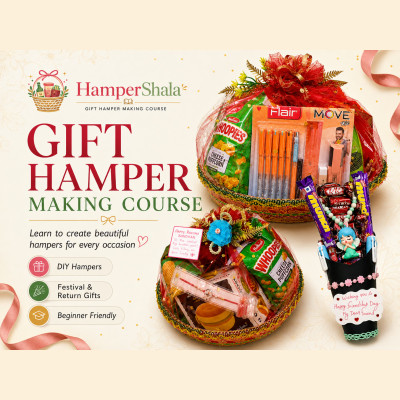
Gift Hamper Shala - Making Course
Learn to create beautiful gift hampers for every occasion — and turn it into a business. Hindi + English · Lifetime…
Rahul Gupta
Rahul built the platform after watching his sisters answer the same WhatsApp question a hundred times. He writes the pricing, selling, marketplace, legal and planning pieces — the parts of a home business that are not about the product.
0 comments
Log in to ask a question or share what happened when you tried this.