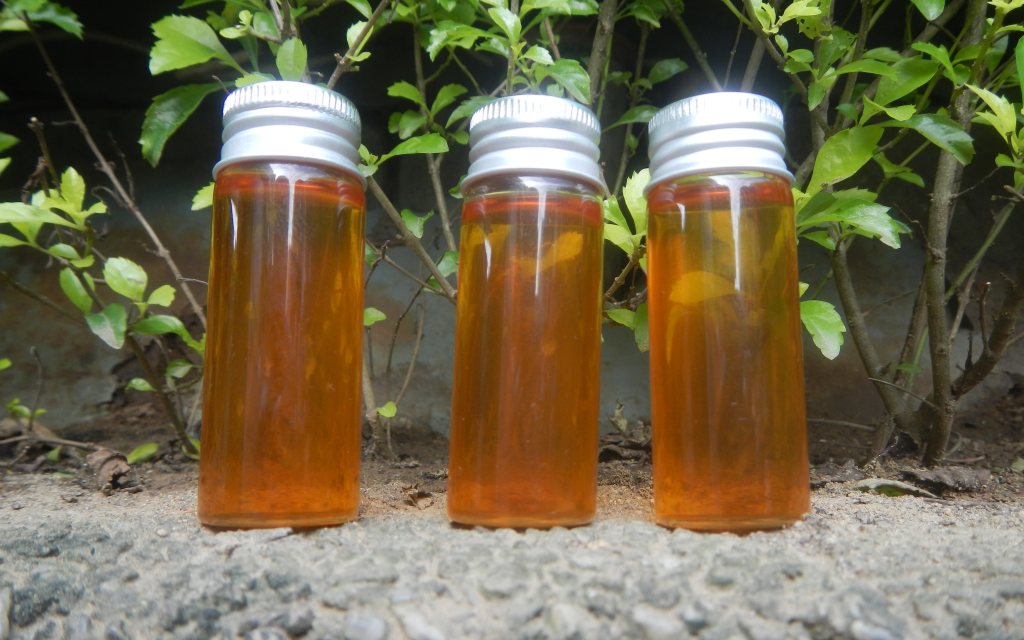
My first five litres of herbal shampoo at home went down the drain on day three. I had soaked reetha, shikakai and amla overnight, simmered them for an hour, strained the decoction through muslin and filled twenty-five bottles. By the third morning every bottle had a grey film on top and smelled like sour dal. Nobody had told me that a decoction is a herbal tea, and tea spoils.
The short version
- A reetha and shikakai decoction is the start of a herbal shampoo, not the finished product. Without a preservative it grows mould in two to three days.
- A sellable bottle has four parts: the herbal decoction, a mild cleansing base, a tested preservative and a pH between 4.5 and 5.5.
- In a 5 litre batch a 200 ml bottle costs me ₹85–₹95 all in and sells at ₹249–₹349.
- Your first customers are the people who already complain to you about hair fall and dandruff. Your next customers are two salons.
- Shampoo is a cosmetic in law. Learn the labelling rules early and check the licence position on the CDSCO portal.
Every second woman I meet in Faridabad has a family recipe for herbal shampoo. Reetha for the lather, shikakai for the cleanse, amla for the shine, sometimes a handful of hibiscus or neem. The recipe works. It has worked for three hundred years.
The trouble starts when you try to put that recipe in a bottle and hand it to somebody else. A wash-and-use decoction and a product with a shelf life are different things, and the gap between them is exactly what this article is about. I make and sell shampoo, hair oil and masks from a two-room unit at home, and the shampoo took me far longer to get right than the other two.
What follows is the version I wish I had read in year one: what actually goes into a bottle, what it costs, what it sells for, and who buys it.
Where it goes wrongA decoction is not a shampoo
Three things happen when you bottle a plain herbal decoction. It spoils, it does not lather the way a customer expects, and it sits at the wrong pH for hair.
Spoilage is the one that shocks people. The decoction is water full of plant sugars and proteins, and at 35°C in a Haryana summer that is a growth medium. I have seen mould in 48 hours. In the fridge you get four or five days. A product that must be refrigerated and used within a week cannot be couriered, cannot sit on a salon shelf and cannot be sold to a stranger.
Lather is the quieter failure. Reetha contains saponins and does foam a little, but a woman who has used a supermarket shampoo for twenty years will rub the decoction into her hair, feel nothing, use half the bottle in a week and go back to what she knows. She will not tell you. She will simply not reorder.
The pH problem is invisible until hair starts to feel rough. Reetha and shikakai water tends to sit around pH 6.5 to 7. The scalp and hair shaft prefer 4.5 to 5.5. Every wash at the wrong pH lifts the cuticle a little, and after a month the customer decides herbal shampoo "does not suit her".
What it really takesThe four parts of a herbal shampoo at home
1. The herbs and the decoction
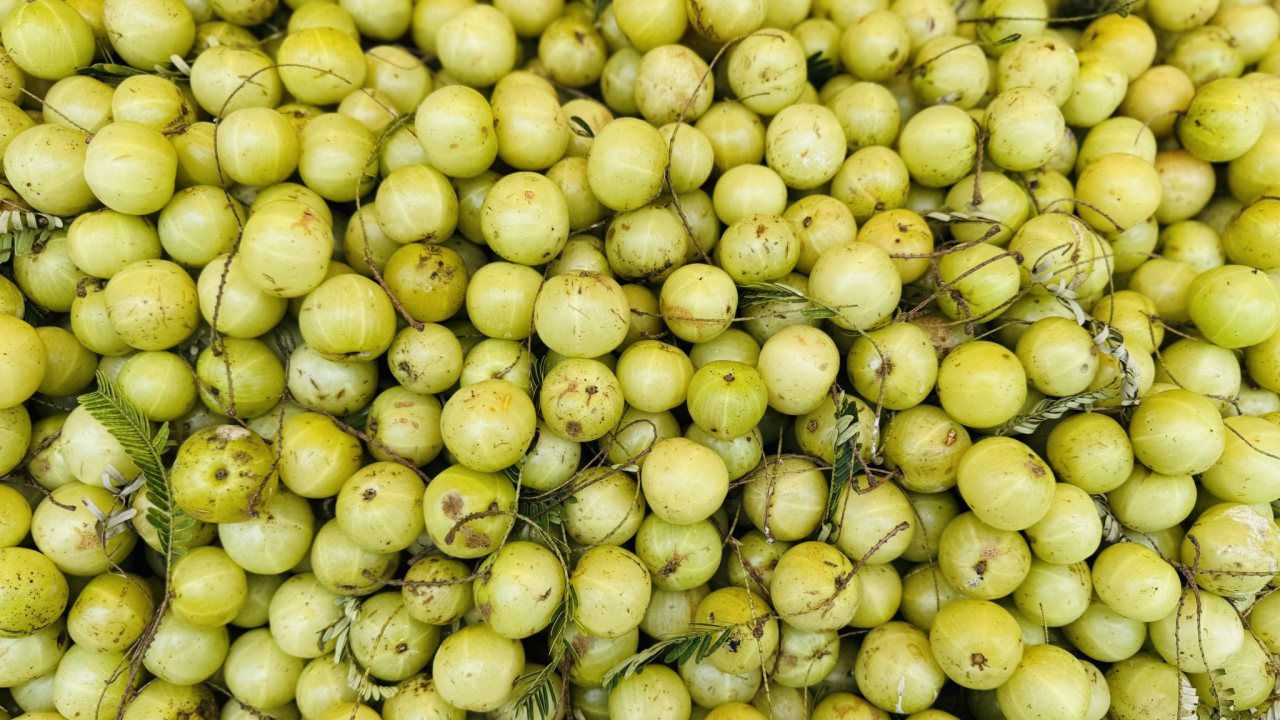
My formula uses thirteen herbs, and the heart of it is the trio everybody knows. Reetha costs ₹150–₹250 a kilo at the Faridabad mandi, shikakai pods ₹180–₹300, dried amla ₹250–₹400. Bhringraj, brahmi, hibiscus, neem, methi and curry leaf add scalp and conditioning benefits and cost ₹150–₹450 a kilo depending on the season. You can buy small packs from the GyaanShala store or a herb wholesaler; I wrote up my suppliers in where to buy raw materials.
Soak the crushed herbs overnight, simmer until the water reduces by a third, strain twice. The decoction should be a clear dark brown. If it is cloudy, you have fine sediment that will settle in the bottle and look like contamination.
2. The cleansing base
This is where the phrase "chemical-free" has to be handled honestly. A mild sugar-derived surfactant such as coco glucoside is made from coconut and glucose, is sulphate-free, and gives a soft creamy lather. It costs ₹450–₹700 a kilo and you use 12–18% of it. It is a manufactured ingredient. I say so on the label, and customers who read labels trust me more for it, not less.
A pinch of a natural gum thickener stops the shampoo running through the fingers. Too much decoction and the base cannot thicken; this is the most common reason a first batch comes out like water.
3. The preservative
Any product with water in it needs a broad-spectrum preservative used within the maker's stated range, usually 0.8–1%. A 100 ml bottle costs ₹400–₹800 and preserves about 10 litres of shampoo. Skipping it to stay "natural" is not a choice you get to make if somebody else will use the product. It is the difference between a cosmetic and a hazard.
4. The pH
Test strips cost ₹150–₹250 for a pack of a hundred. Adjust with a citric acid solution, a few drops at a time, until the strip reads 5. This is the step my students most often skip and most often regret.
If you sell a water-based product without a preservative, someone will eventually open a bottle with black spots in it. In my experience that person posts the photo before she messages you. One photo will undo six months of goodwill.
The methodMaking herbal shampoo at home, one batch at a time
- Weigh, do not guessBuy a kitchen scale that reads in grams. Write every weight in a notebook before you start. A recipe you cannot repeat is not a recipe.
- Soak the herbs overnightCrush the reetha and shikakai, add the powdered herbs, cover with five times their weight in water and leave it eight to twelve hours.
- Heat and reduceSimmer, never boil hard. Boiling scorches the amla and the decoction smells burnt. Reduce by about a third, cool, strain through muslin and then through a finer cloth.
- Build the baseWarm the surfactant gently, add the decoction slowly while stirring, then the thickener. Stir in one direction and slowly, or you whip in air and get a bottle of foam that takes a day to settle.
- Preserve, scent, adjustAdd the preservative at the maker's stated percentage, then an essential oil or fragrance at 0.5–1%, then bring the pH to 5 with citric acid solution.
- Rest and testLeave the batch covered for 24 hours. Check thickness, smell and separation. Wash your own hair with it. Only then fill bottles.
- Keep one bottle backDate it and leave it in your bathroom for four weeks. If it changes colour, separates or smells off, the batch is not ready to sell.
The course goes through this on camera in two parts and then gives the complete formula with every percentage, so you are not reverse-engineering from a paragraph. It also covers a bonus hair toner from the same decoction, which is a useful second product from the same day's work.
CostsWhat a 200 ml bottle actually costs
The table below is my own costing from a 5 litre batch, which fills twenty-five 200 ml bottles. I pay myself ₹150 an hour for three hours of work. If you leave your time out you will price too low, and I explain why in how to price handmade products.
| Item | Per bottle |
|---|---|
| Herbs for the decoction, about 300 g per batch | ₹4 |
| Coco glucoside base, 15% | ₹18 |
| Thickener, preservative, citric acid | ₹15 |
| Fragrance or essential oil, 0.5% | ₹10 |
| 200 ml PET bottle with flip cap | ₹16 |
| Printed label | ₹5 |
| Gas, water, wastage | ₹3 |
| My time, 3 hours at ₹150 | ₹18 |
| Cost per bottle | ₹89 |
Notice what the bottle and label do. They are ₹21 of ₹89, almost a quarter. A glass bottle would push that to ₹40 and make couriering risky. I use amber PET for shampoo and save glass for the hair oil gift line.
A first batch of one litre costs more per bottle, closer to ₹110, because the preservative and surfactant come in minimum pack sizes. Budget ₹3,500–₹4,500 to make your first five bottles and have raw material left for the next forty.
PricingA price people pay twice
Herbal shampoo sells between ₹199 and ₹399 for 200 ml in my market. I sell at ₹299 to households and at ₹190 a bottle to salons who take twelve at a time. Below ₹199 people assume it is a decoction in a bottle. Above ₹399 you are competing with brands that have a lab and a film star.
The number that matters is not the margin on one bottle. It is how many bottles one customer buys in a year. A family of four uses a 200 ml bottle every three to four weeks. A customer who stays with you is worth ₹3,000–₹4,000 a year, which is why the second bottle matters more than the first.
The first bottle is sold by your story. The second bottle is sold by her hair. Formulate for the second bottle. — what I tell every student on day one
SellingThe first thirty customers
Do not start with a marketplace. Start with the ten people who already complain to you about hair fall, dandruff or a dry scalp. Give five of them a 50 ml trial bottle, not a full one, and ask them to message you after three washes. Trial bottles cost me ₹22 each including the bottle and turn into full-size orders about half the time.
Then take a 5 litre can to two salons. A salon in Faridabad does thirty to sixty washes a week and pays ₹900–₹1,200 for 5 litres of a commercial brand. If your herbal shampoo lathers well and the owner's own hair feels good after a week, she will take a can a month and tell her clients where it came from. The whole approach is in selling to salons and parlours.
WhatsApp does the rest. A status update on filling day, a photo of the bottles, a reminder message twenty-five days after each sale. Rahul's guide to selling on WhatsApp and Instagram has the exact message templates.
Nobody messages "the saponin content is excellent". They write "hair feels soft, but less foam than my old one" or "smells like the amla oil my mother used". Both are useful. The first means adjust your base. The second goes on your label.
MistakesSeven that cost me money
- Boiling the decoction hard. Burnt amla smells like a chemistry lab and no fragrance hides it.
- Filling bottles the same day. Air bubbles from stirring make the bottle look half full by morning and customers think they were short-changed.
- Writing "chemical-free" on the label. Water is a chemical. Say "no sulphates, no parabens, no silicones" and list every ingredient. The rules are in how to label handmade cosmetics.
- Buying 5 kg of shikakai to save ₹60 a kilo. It went stale before I used a third. Buy 500 g until you are making a batch a week.
- Skipping the pH strip. Two customers with rough hair, both from the same batch, both gone.
- Couriering in glass. One broken bottle, one shampoo-soaked parcel, one refund and one apology.
- Making a 10 litre batch in month two. I had seven bottles left when they crossed their date.
What nextFrom ten bottles to a hundred
Shampoo is a cosmetic under the Drugs and Cosmetics Act, and manufacturing it for sale needs a state cosmetic manufacturing licence. As of 2026, verify the current position on the CDSCO portal before you list on a marketplace; most of us start in our own circle while the paperwork moves.
Once the shampoo is stable, the same herbs and the same customer buy a hair mask and a hair oil. I cover those in the ayurvedic hair mask business and the ayurvedic hair oil business. Three products from one shelf of herbs is how a ₹300 order becomes a ₹900 order.
If you want the formula rather than the outline, the ShampooShala course films the soaking, the decoction, both halves of the making, the packing and storing and the pricing, in Hindi and English, with the complete formula and a PDF companion. Make one litre first. Keep one bottle back. Then decide.
Still unsureQuestions we get asked
Can I make herbal shampoo at home without any chemicals?
How long does homemade herbal shampoo last?
Does herbal shampoo lather?
What does it cost to make a 200 ml bottle of herbal shampoo?
Do I need a licence to sell herbal shampoo in India?
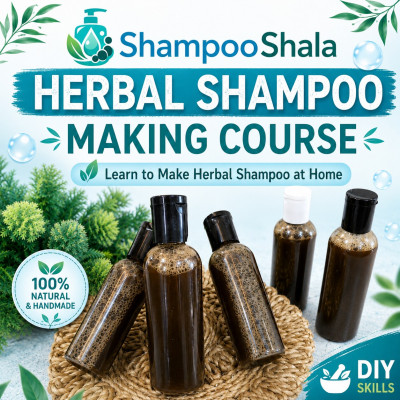
ShampooShala — Natural Herbal Shampoo Business Course
Learn to make salon-grade, chemical-free herbal shampoo from 13 time-tested herbs — and turn it into a home business.…
Anju Mittal
Anju formulates the soap, shampoo, hair oil, face pack, perfume and bath-salt recipes GyaanShala teaches — and sold every one of them from home first, spoiled batches included. She writes the pieces about what goes in the jar, what keeps, and what a salon actually orders.
0 comments
Log in to ask a question or share what happened when you tried this.