In the seventh week, a customer in Faridabad brought back a jar of my almond and oat dry face wash powder because it smelled of old ghee. She was right. I had put almond powder into a product she kept on a shelf beside a hot-water geyser, and it had gone rancid. That one jar taught me more about this product than the first fifty I sold.
The short version
- A dry face wash powder has no water in it, so it needs no preservative, no pH balancing and no leak-proof bottle. It keeps six to nine months.
- One base powder plus three variants for dry, oily and sensitive skin covers every customer you will meet.
- A 50 g jar costs ₹30–₹40 to make and sells at ₹179–₹249.
- It does not foam like a gel. Say so before the customer discovers it.
- Almond and milk powders go rancid first. Keep those variants small and fresh.
Everybody who comes to us wanting to make skincare wants to make a liquid face wash. It is the product they use, so it is the product they imagine selling. It is also the hardest thing in our whole range to get right at home: a surfactant, a preservative at the correct percentage, a pH of about 5.5, a bottle that will not leak in a courier bag, and a formula that does not separate in a Faridabad May. The herbal shampoo took me longer than any other product for exactly those reasons.
A powder cleanser removes every one of those problems at once. It is not a compromise. In most of India it is how faces were washed before the gel arrived, and a good one is a better product than a cheap gel. What follows is the formula, the batch, the cost and the one conversation you will have with every third customer.
Why water-freeThe problem a dry face wash powder solves
Mould and bacteria need water. Every liquid cosmetic is an argument with that fact, and a preservative is how the argument is settled: the right molecule at the right percentage at the right pH, then tested to prove it works. Get any part wrong and the bottle is spoiled in a fortnight, sometimes without any sign until a customer's skin reacts.
Take the water out and the argument ends. A dry powder, properly dried and sealed, keeps six to nine months with no preservative at all, because there is nothing in the jar for anything to grow in. The customer adds the water herself, a few drops at a time, in her palm, and rinses it away thirty seconds later. Nothing wet ever goes back in the jar.
For a seller that means a product that ships light, cannot leak, needs no pump and no plastic bottle, and fits a 50 g jar that goes into a handbag. It is the same logic as a dry face pack, applied to a product that is used every morning instead of every Sunday.
What it isCleansing grains, not a face pack
A face pack sits on the skin for fifteen minutes and is mostly clay. A face wash powder is on the skin for thirty seconds and is mostly flour.
That changes three things. The grind is finer, 100-mesh rather than 80, because it is rubbed in daily and a coarse grain scratches. The clay is much less, ten percent instead of forty, because clay left on the skin every day tightens it. And there is a small amount of reetha powder, five percent at most, which gives a light creamy lather from a natural saponin so that the customer feels something happening.
It cleans in three ways at once: the flours lift oil and dead skin by mild abrasion, the clay absorbs what the flours lift, and the reetha carries it off in the rinse. The skin afterwards feels clean and not tight, which is the whole point, and which is what the customer notices on day three.
The formulaOne base, three skins
Every jar I sell comes from one base. Per 100 g: rice flour 30 g, oats powder 25 g, besan 20 g, kaolin clay 10 g, mulethi 5 g, rose petal powder 5 g and reetha powder 5 g. Then the base is adjusted for the skin it is going to, by swapping a little of the rice flour for the additions in the table. All of the powders are in Khari Baoli, in any pansari, or in the GyaanShala store; buy 500 g of each to begin.
| Variant | What changes from the base | Material per 100 g | Watch out for |
|---|---|---|---|
| Base, normal skin | Nothing | ₹18 | Reetha above five percent stings the eyes |
| Dry skin | Add 10 g almond powder and 5 g milk powder | ₹30 | Rancid in four months; keep batches small |
| Oily skin | Add 10 g neem, 10 g multani mitti, 3 g activated charcoal | ₹21 | Charcoal stains a white basin; say so |
| Sensitive skin | Remove reetha; add 5 g chamomile and 10 g more oats | ₹24 | No lather at all; the customer must be told |
The dry-skin jar is the one people love and the one that fails. Almond and milk powder both carry fat, and fat goes rancid, faster in heat. It is why the jar in my first paragraph came back. I still make it, in half-kilo batches, with a four-month best-before, and I never keep more than ten jars of it in stock.
The batchOne kilo, twenty jars, step by step
- Dry every powder firstTwo hours on a steel tray in the sun, or twenty minutes in an oven at its lowest setting. Rice flour and besan hold more moisture from the shop than you would think.
- Weigh to the gram and write it downBatch number, date, every weight. A customer who reorders in four months wants the same jar.
- Sieve each powder through 100-mesh, twiceThis is finer than a face pack and it matters more, because the product is rubbed into the face every day. Whatever stays in the sieve is not going in.
- Mix in a dry steel bowl for five minutes, then sieve the mixThree sievings in total. It sounds excessive. It is what makes the paste feel like cream instead of atta.
- Test it in your own palmHalf a teaspoon, a few drops of water, thirty seconds on a damp face. You are checking for grit, for lather, and for how the skin feels five minutes after rinsing. Tight means too much clay.
- Fill 50 g jars through a dry funnelWide-mouthed PET or glass, so a scoop fits. Never paper, never a pouch that cannot be resealed.
- Scoop, silica sachet, shrink band, labelThe label carries the batch number, the month, and one line that says to use a dry spoon and keep the jar out of the shower.
- Keep one jar back as the controlOpen it at two months and four months for the dry-skin variant, at three and six for the others. Smell it. That jar is your real shelf life, not the one on a website.
The numbersWhat a 50 g jar costs and earns
The powder is the cheapest thing in the jar. This is a product where the packaging and your time are most of the cost, so a 100 g jar is not twice the price of a 50 g one and a 25 g sample is nearly as expensive to make as the full size.
| Item | Per jar |
|---|---|
| Base powder, 50 g | ₹9 |
| Wide-mouth PET jar with lid, 50 g | ₹8 |
| Wooden scoop | ₹3 |
| Label, shrink band, silica sachet | ₹5 |
| Wastage, sieving loss, sun and gas | ₹2 |
| Your time, three minutes | ₹8 |
| Cost per jar | ₹35 |
On WhatsApp the jar sells at ₹179. Boxed with a face pack as a two-jar set, ₹399–₹449, and that set is the thing that goes as a wedding or Diwali favour in tens. The dry-skin variant costs about ₹6 more and I price it the same, because customers do not understand why almond should cost extra and I do not want the conversation. The pricing logic behind all of this is in how to price handmade products.
Foam is a habit, not a wash. A powder that does not lather is not failing. It is doing something else. — what I say at every exhibition table
SellingThe foam objection and who actually buys dry face wash powder
Every third customer says the same thing: "ye jhaag nahi banata". It does not foam. She has used a gel for twenty years and foam is what clean feels like to her.
Do not argue. Put a pinch in her palm, add water from the bottle you have carried for this purpose, and let her rub it on the back of her hand and rinse. The lather is light and creamy, and the skin afterwards is what sells the jar. The ones who switch stay switched.
Who buys, in the order I see them. Women past thirty who have found that gels leave their skin tight in winter. Mothers buying the oily-skin jar for a teenage son who will not use anything that smells of flowers. Anyone who travels, because a 50 g jar of powder goes through airport security and cannot spill in a bag. And, increasingly, people who simply do not want another plastic pump bottle in the house.
WhatsApp and Instagram are where the first fifty jars go, and Rahul's WhatsApp and Instagram guide is the method. This is also one of the few products in our range that suits Amazon early, because it ships light, cannot leak and does not mind a hot courier van; his marketplace piece is honest about what that costs in fees and time.
"Use a dry spoon. Keep away from the shower." Print it on every jar, under the directions. Half the spoiled jars that come back were spoiled by a wet finger, and that line puts the customer on your side.
Where it goes wrongWet fingers, rancid almond and the grind
The wet finger. A customer dips wet fingers into the jar after her shower. The powder cakes, then it moulds. The scoop, the wide mouth and the label line above are the whole defence. A jar without a scoop is a jar that will come back.
Rancid almond. The dry-skin variant, kept beside a geyser. Fat oxidises with heat and time, and vitamin E does not rescue a powder. Small batches, a short best-before, and never more than ten jars in stock.
Too coarse. A powder that felt fine in your palm is scratching the cheek of a woman who rubs harder than you do. 100-mesh, sieved three times. If your sieve is 80-mesh, this is a different product.
Too much clay. More than ten percent and dry-skin customers report tightness within a week. Clay is for a Sunday mask, not a daily wash.
The claims. "Removes blackheads", "cures acne", "whitening": any of those turns a cosmetic into a drug and, as of 2026, into a different licence entirely. "For oily skin" and "daily cleansing powder" are cosmetics. How to label handmade cosmetics lists what the label must carry; verify the current rules on the CDSCO portal before you print.
Not the customer's bathroom only: yours. Do not store stock in the room where the geyser is. A closed steel dabba in a bedroom cupboard, with a silica sachet, is where a season's jars should sit. What humidity does to a powder is covered in shelf life of handmade products.
What nextFour formulations and a handbook
The base and the three variants above are the four formulations filmed start to finish in the Dry Facewash Shala course, with the ingredient lesson before them and, after them, how to use the powder on the skin, packaging and moisture control, and a module on selling and branding. It comes with a bilingual English and Hindi handbook, because the person who will help you sieve a kilo on a Sunday may prefer the Hindi page.
This week, make one kilo of the base. Sieve it three times. Put a pinch in your own palm and feel the difference from the second sieving to the third. Then fill twenty jars, keep one, and sell the base to the people who already buy your face pack.
Still unsureQuestions we get asked
What is a dry face wash powder and how do you use it?
Why does a dry face wash powder need no preservative?
How much does a dry face wash powder cost to make and what does it sell for?
Does dry face wash powder foam?
Which skin types can a dry face wash powder be made for?
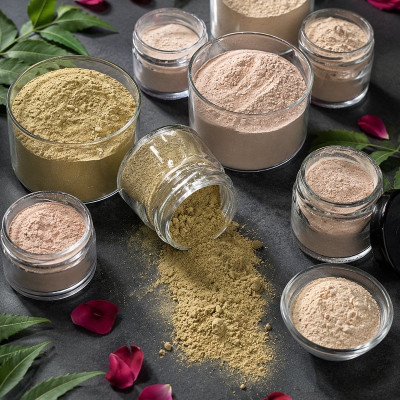
Dry Facewash Shala — Herbal Dry Facewash Powder Business Course
Learn to make herbal dry facewash powder at home - a water-free, preservative-free skincare product that keeps for…
Anju Mittal
Anju formulates the soap, shampoo, hair oil, face pack, perfume and bath-salt recipes GyaanShala teaches — and sold every one of them from home first, spoiled batches included. She writes the pieces about what goes in the jar, what keeps, and what a salon actually orders.
0 comments
Log in to ask a question or share what happened when you tried this.